

Written By: Ian Kerns, LMFT & Jordan Arneson, tLMFT
Family is complicated as it is. And when two people begin building a life together, each brings their own beliefs, values, and experiences shaped by the families they grew up in. But what happens when their values don't align?
This is a topic we often explore in marriage and family therapy, especially when a couple has children. As a parent, you want to instill the values that are most important to you while also preparing your kids to navigate life. But when parents disagree on important values, it can create tension and lead to conflict.
Conflict is a natural part of any relationship. What matters most is how you handle it.
How Family Conflict Shapes a Child’s Behavior
Children learn by observing the people around them, especially their parents. And the patterns they observe in their formative years can have lasting effects, influencing how they communicate and interact in their own relationships.
For instance, if a child grows up watching their parents resolve conflicts by yelling, they are more likely to respond to conflict with yelling as adults. And if your child sees you using open communication, mutual respect, and thoughtful compromise to resolve a conflict, they are more likely to model those behaviors.
Even if you and your partner don't share the same values, you can learn to navigate those differences productively. The following two models illustrate how families may approach disagreements about values and how those approaches can influence family dynamics.
Model A: Family Value Integration
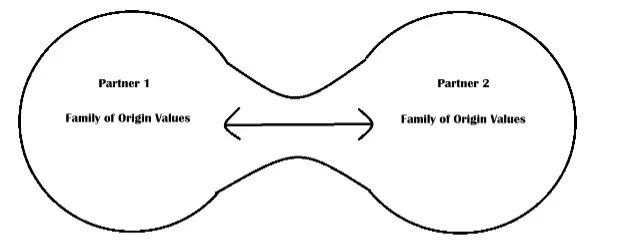
In Model A, you'll notice that the circles are connected but remain separate, representing two partners with their own individual value systems. The connection between them illustrates the ability to have honest, open conversations about values that may not align. Rather than becoming defensive or combative, they work together to determine which values they want to incorporate into their family.
That doesn’t mean disagreements won't happen. It just means that when they do, you are willing to listen and understand one another's perspectives. This creates opportunities for compromise and healthier communication.
This approach positively influences interactions between parents, parents and children, and siblings.
Model B: Family Values Clash
Model B tells a different story.
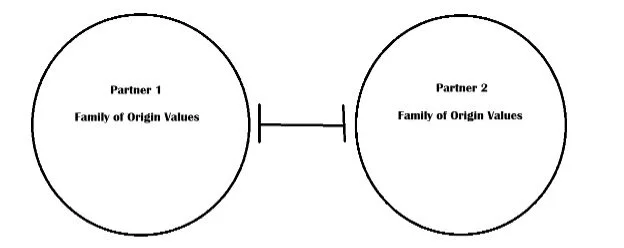
Here, the partners’ values are misaligned, and both become closed off to conversations that feel unsafe or uncomfortable. Rather than working through their differences, communication breaks down, and disagreements can turn into ongoing, unproductive conflict.
In families experiencing these dynamics, several unhealthy communication patterns may emerge.
Triangulation occurs when another family member or object becomes a mediator between two people who struggle to communicate effectively with one another.¹
Coalitions are smaller alliances that form between certain family members, rather than the family functioning as a unified whole.²
In some cases, one family member may become the family scapegoat, meaning they are blamed or targeted as a distraction from deeper, underlying family issues.³ This could be a child who is struggling with conflicting family values and begins exhibiting behaviors that others label as "bad" or "defiant."
These patterns can develop for several reasons, including the assumption that one person's values are right and the other's are wrong. It can also vary depending on the specific values being discussed or on communication habits learned from one's own family growing up.
While disagreements about values are inevitable, they don't have to lead to unhealthy conflict. Learning to communicate openly and navigate differences can help families work toward greater understanding.
3 Ways to Navigate Conflicting Family Values
If you recognize some of these patterns in your own family, there are steps you can take to improve communication and work toward finding common ground.
1. Identify the Purpose of the Discussion
Before beginning a difficult conversation, take a moment to identify what needs to be discussed, what you're hoping to resolve, and why it's important.
Without a clear purpose, disagreements can quickly get off track. What begins as a discussion about differing values may turn into name-calling or an opportunity to vent built-up frustrations, leaving both partners feeling even more disconnected.
2. Listen to Understand, Not to Argue
When you disagree with your partner, it can be tempting to focus on finding counterarguments to everything they're saying. But remember, you're navigating a relationship, not arguing a case in a courtroom.
Instead, try to understand why a particular value or belief is important to your partner.
Taking the time to understand their perspective may change how you view the issue and help you better understand its significance to them. Likewise, your partner should be willing to understand why your values and beliefs matter to you.
The goal isn't to agree on everything, but to create space for understanding and productive conversations.
3. Be Radically Honest
For many people, opening up about how they truly feel doesn't come easily. In therapy, we often see that it takes time for individuals to feel comfortable expressing their thoughts and emotions honestly.
But once it happens, it can make a noticeable difference in relationship dynamics. Partners can develop a greater sense of understanding, which helps build trust.
Being radically honest doesn't mean being hurtful or vicious with your words. It means communicating openly about what matters to you, how you feel about a particular topic, and why it's important.
Consider Professional Support
If you and your partner are struggling to find common ground or resolve ongoing conflict, consider marriage and family therapy. Meadowlark can provide a supportive space to explore differences in values, identify unhealthy communication patterns, and develop strategies for working through disagreements in healthier ways.
Contact us today at (319) 626-3300 or visit meadowlarkpsych.com to learn more.
Connect with a Meadowlark therapist to get started.
